

It’s refreshing to learn that Treasurer Jim Chalmers is willing to entertain more substantial tax reforms than the ones which Labor took to this year’s election (principally, the proposed increases in taxation of superannuation balances worth more than $3 million) in order to “ensure that the budget is put on a sustainable footing”.
It has been evidence since the last budget of the former Coalition government, presented by then Treasurer Josh Frydenberg in March 2022, that federal government spending is likely to be permanently higher, by between 1.5 and 2 percentage points of GDP, over the next decade than the average which prevailed between the end of the Whitlam years and the onset of the Covid-19 pandemic.
Chart 1: Federal government cash receipts and “underlying” payments

Note: “Underlying payments” excludes “investments in financial assets for policy purposes” (also known as “off-budget spending” which are projected to average 0.7% of GDP over the five years to 2028-29, comparing to 0.2% of GDP over the ten years to 2023-24. Source: Jim Chalmers and Katy Gallagher, 2025–26 Budget Paper No. 1, Statement 10: Historical Australian Government Data, 25th March 2025.
There are three reasons for that:
- first, voting patterns and widespread support for increasing government expenditure on a variety of programs suggest that the public want more spending on health, aged, disability and child care;
- second, there is a bi-partisan consensus that, whether the public wants it or not, they are going to get more spending on defence; and
- third, because of the $600 billion increase in net debt since the onset of the global financial crisis, and the projected $391 billion further increase in net debt over the next decade, there is unavoidably going to be more spending on interest.
Some combination of expenditure restraint and additional revenue will be required. It’s far from obvious that this additional spending can be sufficiently offset by cuts to spending in other areas of the budget (although scrapping the obscene WA GST deal – which was most recently estimated to cost $60 billion over the 11 years to 2029–30 – would be a very good step in that direction).
So what could the treasurer contemplate, if he is serious about raising additional revenue, of between 1 and 2 percentage points of GDP, in order to pay for this additional spending and put the budget on a sustainable trajectory, in the fairest and least economically damaging way?
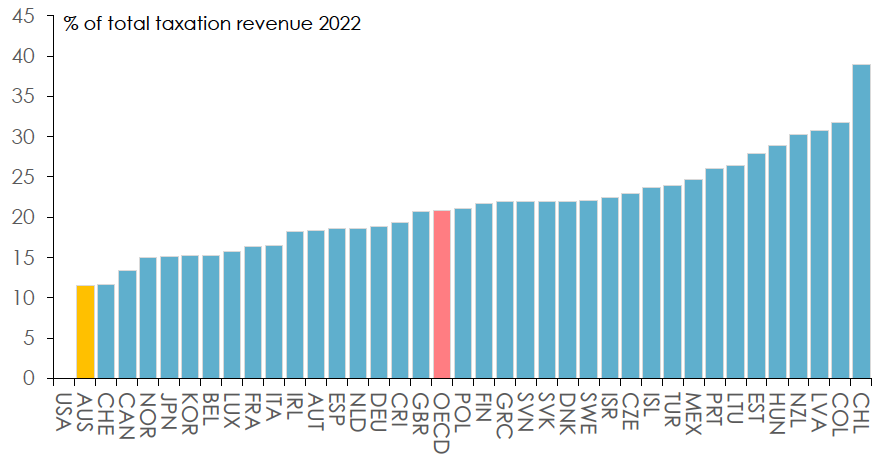
In principle, one of the first “cabs off the rank” should be an increase in the rate and a broadening of the base of the GST. Australia’s GST contributes only 12.5% of total taxation revenue, less than every other OECD country except the US, which doesn’t have a GST, and well below the OECD average of 20.75%.
Chart 2: GST (VAT) revenue as a percentage of total taxation revenue, OECD countries, 2022
 Source: OECD, Consumption tax trends 2024.
Australia’s GST rate of 10% is (along with Japan’s) lower than all but two (Canada and Switzerland) of the OECD countries which have a GST-type tax, and well below the OECD average rate of 19.2%: 23 out the 37 OECD countries have standard GST rates of 20% or higher (although many of those countries apply lower rates to “essential” items like food and, more recently, energy). Australia’s GST only applies to 50% of total final consumption expenditure, less than in 26 of the 37 OECD countries with a GST, below the OECD average of 58%, and well below New Zealand’s 96%.
However, as a practical matter, no federal government is ever going to wear the political odium of raising the rate or broadening the base of the GST, and bear the financial burden of compensating up to one-third of all households for the impact of doing so on them, whilst state and territory governments get to spend the resulting additional revenue, as would occur under our present system which allocates all the revenue from the GST to them.
So the “nexus” between GST revenues and federal “untied” grants to the states and territories would need to be broken before this, otherwise highly desirable, reform, could be implemented.
In that context, it’s worth remembering that among the reasons why the Howard government decided to allocate the revenue from the GST to the states – apart from as an incentive for them to abolish a number of inefficient state taxes – were, first, to absolve the federal government of having to make an annual decision as to how much to give the states and territories by way of financial assistance grants (a decision which would inevitably be greeted with howls of protest by premiers and chief ministers); and second, to allow the Howard government subsequently to pretend that the revenue from the GST wasn’t a federal revenue, and that payments of that revenue to the states and territories weren’t a federal expenditure, so that both could then be excluded from the federal budget, thereby allowing it to claim that it was the lowest-taxing and spending government since the 1970s . That fiction wasn’t corrected until the 2008-09 Budget.
There is one major objection to collecting more revenue from the GST – namely, that it’s potentially regressive, because lower-income households spend a larger proportion of their income, and hence would be proportionately more affected by an increase in the rate of GST, than higher-income households.
That’s a legitimate concern. One way of addressing it, which is quite common in European countries where the standard rate of VAT is much higher than Australia’s GST, is to have lower rates on “essential” items. It’s also worth noting that many of the items currently exempt from GST in Australia, such as private health insurance premiums and private school fees, constitute a larger proportion of the spending of higher-income households than of lower-income ones – so broadening the base of the GST would not necessarily be “regressive”.
But in order to “sell” an increase in the rate and/or broadening of the base of the GST, it would seem sensible – as well as being justified on other grounds – to include some “progressive” tax reforms in any comprehensive reform package: that is, measures which have a larger impact on higher-income households than on lower-income ones.
In this context it’s worth noting that, according to the latest available (2022-23) Taxation Statistics from the ATO, 45% of the income reported by taxpayers in the top tax bracket was in forms other than wages and salaries or interest, compared with 18% of the taxable income reported by taxpayers who weren’t in the top tax bracket. Equally notable is that income in forms other than wages and salaries made up just over 72% of the income reported by people aged 65 or over, as against less than 21% of the income reported by people aged between 18 and 65.
That’s significant, because income in forms other than wages and salaries can often be chanelled through other structures (such as businesses or trusts) to achieve a lower tax rate. Owner occupied housing and superannuation are very lightly taxed relative to other forms of savings and income paid out of superannuation funds in the “retirement phase” isn’t taxed at all.
So the concessional treatment of income in forms other than wages and salaries or interest disproportionately benefits higher-income and older households, at the expense of lower- and middle-income, and younger households.
And that in turn suggests that a “progressive” reform of the income tax system, justifiable in its own right, but especially as a counter-balance to an arguably “regressive” increase in the GST, would be to reduce the generosity of the tax treatment of these other forms of income, compared with that of wages and salaries or interest. That could be done, for example by reducing the 50% tax discount on capital gains, curbing negative gearing, taxing trusts as companies, or taxing payouts from superannuation funds.
Alternatively, it could be achieved by adopting the schedular system used in Nordic countries under which income from “capital” is taxed at a flat rate with no tax-free threshold.
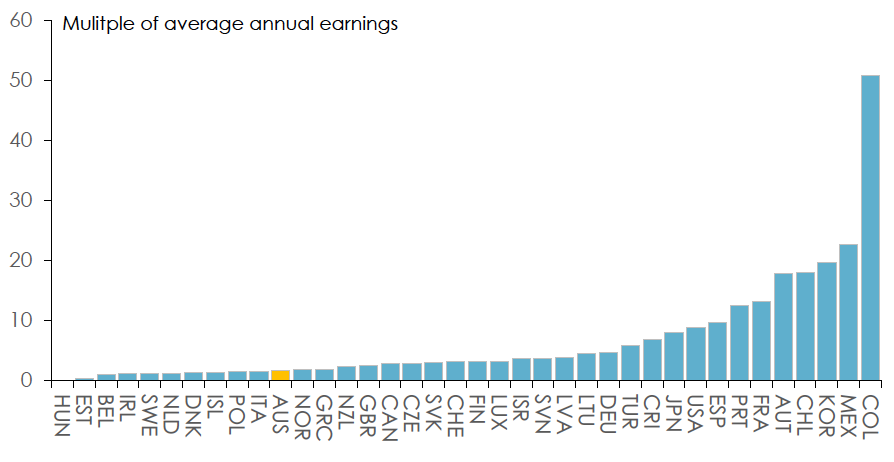
In order to make those changes more politically “saleable”, an appropriate quid pro quo could be a significant increase in the threshold at which the top rate of income tax becomes payable. Australia’s top personal income tax rate (of 47%, including the Medicare levy), is in the middle of the range for OECD countries. But the threshold at which it becomes payable – just 1.7 times average annual earnings – is very low by OECD standards, as shown in Chart 3.
Chart 3: Top personal income tax rate threshold as a multiple of average earnings, OECD countries, 2024
 Source: OECD, Data explorer.
Depending on how much additional revenue was produced by reducing the concessional tax treatment of non-labour income and by raising the rate or broadening the base of the GST, it could be possible to reduce the marginal income tax rates paid by lower- and middle-income earners.
And the tax scales should be indexed for inflation, as they are automatically in 17 OECD countries. A particularly sensible suggestion is Westpac Chief Economist Luci Ellis’ proposal that income tax thresholds should be increased by 2.5% (the mid-point of the Reserve Bank’s inflation target range) annually, so that when inflation is above (below) the target band, fiscal policy is automatically tightened (loosened), which would take some of the burden of responding to fluctuations in inflation off monetary policy and dampen swings in interest rates.
In addition to making a meaningful contribution to “budget repair”, and to improving the equity of Australia’s tax system, tax reforms which seek to increase incentives to work (through reductions in tax on labour income) and to invest in income-generating assets rather than assets whose primary purpose is to produce capital gains (that is, speculation) could also contribute to the goal of improving Australia’s productivity performance.
Some – especially business groups – argue that Australia’s company tax rate should be cut in order to improve incentives for investment.
It’s true that Australia’s statutory company tax rate of 30% is relatively high by international standards. But because of Australia’s dividend imputation system, any reduction in that rate would, for Australian shareholders (including Australian superannuation funds) would be offset by an increase in the rate payable on their dividends. The only beneficiaries of a cut in the company tax rate would be companies which retain most or all of their earnings rather than paying out dividends, foreign shareholders in Australian companies (who aren’t eligible for imputation credits), and wholly-owned foreign companies operating in Australia. It’s far from clear why they should get a tax cut. This may still be a desirable thing to do if investment and economic growth respond to lower taxes. At least some of the incidence of corporate tax falls on workers, so workers may benefit from higher wages and more jobs.
Moreover, international evidence suggests that cuts in statutory corporate tax rates in recent years have done little to stimulate business investment: recent research from the OECD suggests that the sensitivity of business investment to changes in corporate tax rates has declined since the global financial crisis. As shown in Chart 4, the cut in the US corporate tax rate from 35% to 21% instituted from the beginning of 2018 during the first Trump Administration did not prompt any significant increase in business investment – which had been rising steadily from its post-GFC lows over the preceding eight years (although it did prompt a sharp increase in share buy-backs).
That conclusion is re-inforced by a survey of the econometric evidence on the impact of the Jobs and Tax Cuts Act 2017 published in April this year by the US Congressional Research Service. Rather, the Trump corporate tax cuts prompted a surge in corporate share buy-backs, and hence in senior executive remuneration.
Chart 4: US business investment as a percentage of GDP
 Source: US Bureau of Economic Analysis, Gross Domestic Product, 29th May 2025.
Likewise, corporate tax cuts in Canada and the UK do not appear to have had any appreciable effect in boosting business investment (and the UK corporate tax cuts were largely reversed by the previous Conservative Government in 2022).
The Australian evidence is less conclusive, in part because there haven’t been any “across-the-board” cuts in corporate tax rates since the late 1980s, successive Australian governments having instead preferred specific investment allowances (such as “instant asset write-offs”) or reductions in corporate tax rates for small and medium-sized enterprises.
That’s not to say that measures to boost business investment would not be appropriate. On the contrary, as recently-published research by the Reserve Bank has shown, slow growth in business investment over the past 15 years has contributed to growth in labour productivity.
But tax reforms specifically targeted at incentivising increased investment – such as accelerated depreciation, or “instant asset write-offs” – are more likely to produce that outcome than cuts in the company tax rate.
The task of budget repair would also be aided by reforms directed towards more effectively taxing economic rents, including from fossil fuel exports as advocated by Ken Henry and Ross Garnaut. Despite the attempts during the Albanese
Government’s first term to strengthen the petroleum resources rent tax, it is projected to raise only $1.7 billion per annum over the next four years, which is just $57 million (or 3.5%) more than it did on average over the ten years to 2008-09, even though Australia’s LNG exports are now running at over $65 billion per annum, compared with just $4 billion per annum in the ten years to 2008-09.
And, as I suggested here earlier this month, serious consideration should be given to re-introducing a federal inheritance tax, given estimates that almost $5.5 trillion is likely to be transferred from baby-boomers to their 50- and 60-something offspring over the next two or three decades. But that may well require more “political capital” than the Government is willing to risk.
Finally, the states and territories should be part of any serious conversation about tax reform. They impose one of the most inefficient and economically burdensome in the armoury of Australian governments, stamp duties, which could and should be replaced by a broadly-based land tax that includes the “family home”, accompanied by transitional provisions to prevent “double taxation” of recent property purchasers. But it’s not just about efficiency. As David Thodey cogently argued in the review of federal financial relations which he undertook for the former NSW Government in 2021, there is something fundamentally unfair about a system of property taxation which requires people who, for whatever reason, move home several times during their lifetime to contribute more to the cost of providing schools, hospitals and police services than someone who lives in the same home for their entire adult life.
The federal government could encourage the states and territories to pursue this reform by assisting them with the cost of managing the transition – which it should do given that federal revenues are likely to be boosted by the broader impact of more efficient land use which this reform would generate. But if the states aren’t prepared to do that, the federal government could alternatively re-introduce the land tax which previous federal governments maintained between 1910 and 1954, and give the revenue to the states on the condition that they abolished their stamp duties.
The states and territories should also be encouraged to abolish or substantially reduce the tax-free thresholds in their payroll tax systems, which result in the foregoing of substantial amounts of revenue ($3.9 billion in NSW in 2024-25, or 30% of the revenue actually collected, $2 billion in Victoria). There is absolutely no evidence to support the widely-held view that payroll tax exemptions for small business do anything to boost employment: on the contrary, research by the e61 Institute suggests that these concessions are detrimental to employment growth, by encouraging small businesses to limit their employment to just below the threshold at which they become liable to pay payroll tax.
More broadly, payroll tax is actually very similar to the GST in its operation and incidence. GST taxes the difference between sales revenue and cost of goods sold (which is why it is called a “value added tax” in Europe, where it was first conceived).
But as a moment’s thought will confirm, the difference between sales revenue and cost of goods sold is, for most businesses, wages and salaries (plus labour on-costs) plus sales and marketing expenses and what the national accounts call “gross operating surplus”. So the only practical differences between GST – which is widely considered a “good tax” – and payroll tax – which is routinely derided as a “tax on jobs” and therefore a “bad tax” – are that the GST taxes the gross operating surplus as well as wages and salaries, and the GST doesn’t tax exports.
Moreover, most other “advanced” economies levy much higher payroll taxes than Australia does – they just call them “social security contributions” or “social insurance taxes” rather than “payroll tax” – without resulting in higher unemployment than in Australia.
Tax reform isn’t a “magic bullet” that can solve all of the economic and other challenges which confront Australia. But it can make an important contribution to addressing many of them. The prime minister and the treasurer have indicated that they’re willing to spend some of the enormous amount of political capital which they now have in the aftermath of last month’s election. That’s very encouraging. It’s up to others to help ensure, by approaching forthcoming conversations about tax reform with open minds and vested interests left behind, that that political capital is spent in the most effective way.
This post was originally published as part of the Tax and Transfer Policy Institute Policy Brief series.





Recent Comments