

Australia’s public healthcare system is financed predominantly through general taxation. This funding structure imposes two related obligations on policy: public expenditure must be allocated efficiently, and the services it purchases must be accessible to the population irrespective of geography or income. A system that reaches only the well-located fails on equity grounds; one that is accessible but poorly targeted fails on efficiency grounds. Both criteria are the appropriate benchmarks against which reforms and new technologies should be evaluated.
Telemedicine has been promoted as a technology that can help satisfy both requirements at once. Before COVID-19, utilisation of remote consultations in general practice was tightly restricted. That changed almost overnight in March 2020, when the federal government introduced subsidised telemedicine items to keep primary care running through lockdowns. The response was immediate and large: within a month, telemedicine accounted for roughly a third of all standard general practitioner (GP) consultations. Although usage has since settled at a lower level, remote consultations remain a routine and a permanent part of publicly funded primary care.
A cheaper way in, for people who found it hardest to get in
The case for telemedicine is straightforward. Removing the need to travel and wait in a waiting room lowers the cost of seeing a doctor, in time as much as in money, for everyone. For people who previously found it hard to access a GP, whether because of distance, mobility, caring responsibilities or simply an inflexible workday, that reduction in cost can be the difference between seeing a doctor early and not seeing one at all. Delayed or forgone primary care tends to show up later as more expensive and harder-to-treat problems in emergency departments and hospitals, so improving early access has the potential to reduce costs to the health system over time, not just to the individual patient. Better matching between patients and doctors, and more efficient use of GPs’ limited consulting time, point in the same direction.
But does it hold up on quality?
None of this is much use, however, if remote consultations come at the cost of clinical quality. Whether a phone or video call allows a GP to make the same decisions they would make in the room with a patient, without a physical examination and without some of the usual cues, is a genuinely open question, and one that has generated real concern among clinicians and policymakers alike. Access and efficiency gains are only worth having if the care that people receive remotely is as good as the care they would have received in person.
To make quality measurable, we focus on a clinical decision where guidelines are explicit enough to judge whether a prescribing choice is appropriate or not: antibiotic prescribing in general practice. Antibiotics are important in their own right: Australia’s prescribing rates are high by international standards, and unnecessary use contributes to antimicrobial resistance, a problem the World Health Organization ranks among the most pressing threats to global health. Antibiotics also let us ask a broader question about diagnostic and prescribing quality under telehealth, using an outcome that is precisely measured in administrative data and clearly benchmarked against clinical guidelines.
Using linked, administrative records covering the population of GPs and patients in Australia’s Medicare, we classified GPs by how intensively they took up telehealth once subsidised services became available. Our study then compared antibiotic prescribing rates between high- and low-intensity adopters before and after the policy change. Because the timing of the rollout was set nationally and adoption varied a great deal across otherwise similar doctors, we can plausibly attribute differences in prescribing behaviour that opened up after the reform, and not before it, to telemedicine itself, rather than to who happened to take it up.
What we found
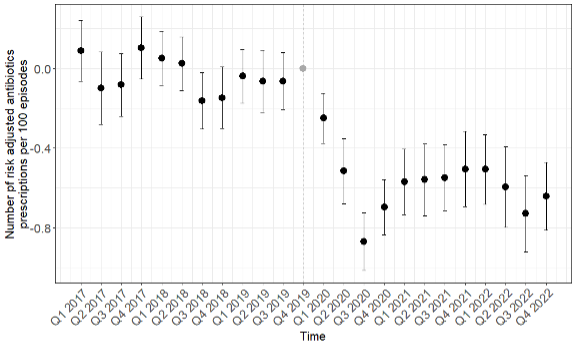
Figure 1 plots risk-adjusted antibiotic prescriptions per 100 episodes for GPs who adopted telemedicine more intensively, relative to those who adopted it less intensively, benchmarked against the quarter immediately before the policy change (Q4 2019). It shows that prescribing rates among high-intensity adopters fell significantly from the first quarter of 2020, consistent with the timing of the reform, and remained lower thereafter, suggesting a persistent shift in prescribing behaviour rather than a temporary pandemic effect.
We estimate that GPs who adopted telemedicine more intensively prescribed around five per cent fewer antibiotics than lower-intensity adopters after the reform. Crucially, this reduction was not achieved by cutting corners. We looked specifically at prescribing for respiratory tract infections, the textbook case of low-value antibiotic use, since these are largely viral and rarely warrant antibiotics under current guidelines, and found no evidence that high-intensity telehealth adopters were less likely to follow them. If anything, guideline adherence for this group was marginally better.
While we do not observe GPs’ reasoning for prescribing antibiotics, we discuss several plausible explanations for our findings. First, telemedicine makes short follow-up consultations easier to arrange, so a doctor can ask a patient to check back in a few days rather than prescribing “just in case”. It may also ease some of the interpersonal pressure that doctors report feeling in face-to-face consultations, where patients sometimes expect or request antibiotics regardless of clinical need. Furthermore, by lowering the cost of consulting a doctor, telemedicine appears to have freed up GP time that would otherwise have gone toward prescribing as a way of managing constrained appointments.
Policy implications
In sum, in the case of antibiotic prescribing, we find that telehealth delivers the same, or slightly better, quality of care as in-person consultations. This is a meaningful result for a tax-funded system moving toward a permanent, publicly funded telehealth offering. For policymakers designing the long-term shape of Medicare-funded telemedicine, the implication is not that remote care should replace face-to-face consultations, but that concerns about quality should not be assumed to rule telemedicine out either. A tax-financed system has to answer for how efficiently it spends public money and how well it reaches the people who need care most. Our findings suggest that telemedicine can expand access and support more efficient use of GPs’ time without asking Australians to trade away the quality of the care they receive.






Recent Comments